Know Your Default Communication Style

Updated: Jun 10

“95% of us think we’re self-aware. Only about 10-15% actually are.” So says organisational psychologist Tasha Eurich, writing in Harvard Business Review.
I talk for a living, and for years I still got my own default communication style wrong. We all communicate constantly: briefings, one-to-ones, the quick “have you got a sec?”, the message fired off between meetings. But I rarely stopped to ask the question that actually matters. Not what I said, but how I came across.
Most of us have a default communication style, a mode we reach for automatically, especially under pressure. It has a superpower. It also has a blind spot. And because it feels like “just being ourselves”, we rarely notice it at all.
In this piece I’ll show you what a communication style really is, the styles you’ll recognise in yourself and others, why yours matters more the more senior you get, and the honest ways to see your own, including the one that finally worked on me. It builds on reflection and emotional intelligence, the quiet skills behind every good conversation.
Contents
What is a communication style?
A communication style is your habitual way of expressing yourself and responding to others, your tone, pace, directness, and how much emotion you show. Your default is the version that shows up automatically when you’re rushed, stressed or challenged, before you’ve had chance to think.
The good news: style is learned and habitual, not fixed personality. Which is exactly why reflection can shift it.
The main communication styles
There is a more reliable map, and it comes from decades of research. When we read other people, and when they read us, we tend to do it along two independent dimensions (Bakan, 1966; Wiggins, 1991; Abele and Wojciszke, 2014).
Agency: how assertive or dominant you come across, from take-charge and forceful to quiet and accommodating.
Communion: how warm you come across, from openly caring and relational to cool and task-focused.
The key point is that these are separate. Being assertive does not make you warm. You can sit high on one and low on the other, which is why two equally confident leaders can land completely differently.
Put together, that gives four broad blends:
Assertive and warm: direct, and people feel you are on their side.
Assertive and cool: clear and fast, but it can read as cold or steamrolling.
Reserved and warm: supportive and easy to be around, but people may not know where you stand.
Reserved and cool: calm and considered, but it can seem distant or hard to read.
Practitioner tools build on these same two dimensions. We use DISC in our work, and you may know the Social Styles model; both are accessible takes on agency and communion. Kim Scott’s Radical Candor maps neatly too: challenge directly is agency, care personally is communion.
One important caveat: how your style is read is not always fair. The same behaviour gets judged differently depending on who you are, and women in particular get caught in a double bind, called too aggressive when they are assertive and too soft when they are warm. This is close to my own research on gender diversity in leadership, and it is the heart of Alison Fragale’s Likeable Badass, a favourite of mine on holding warmth and assertiveness at the same time.
🧐 Example: in a tense review, a leader who is high on agency and low on communion snaps to “So what’s the fix?”. Efficient, but it can shut down the person who was about to flag the real risk.
Why your default communication style matters
Your style doesn’t just affect one conversation. As a leader, it sets the weather for the whole team.
The more senior you are, the more your default gets amplified. A throwaway sigh, a curt reply, a habit of jumping straight to solutions. These are the small things you barely register, but everyone around you reads them closely. That’s how communication style quietly shapes psychological safety, trust, and the quality of the decisions your team is willing to bring you.
Get it right and people speak up, challenge early, and tell you the truth while it’s still useful. Get it wrong and you become the last to know.
The blind spot: why we can’t see our own style
We judge ourselves by our intentions. Everyone else judges us by our impact. You meant to sound decisive; they heard “don’t argue with me”. You meant to be warm; they heard “she’ll never actually make the call”. This gap, between intent and impact, is the blind self in the Johari Window, and it’s where most communication problems live.
Here is my own blind spot. For years I thought I came across as too soft. Then I asked a handful of colleagues and friends for three words to describe me, and the answer floored me: the word that kept coming up was warm and tough. The gap between the soft I felt and the strength others saw is the Johari Window blind spot in action, and one daft little three-word question is what finally showed it to me.
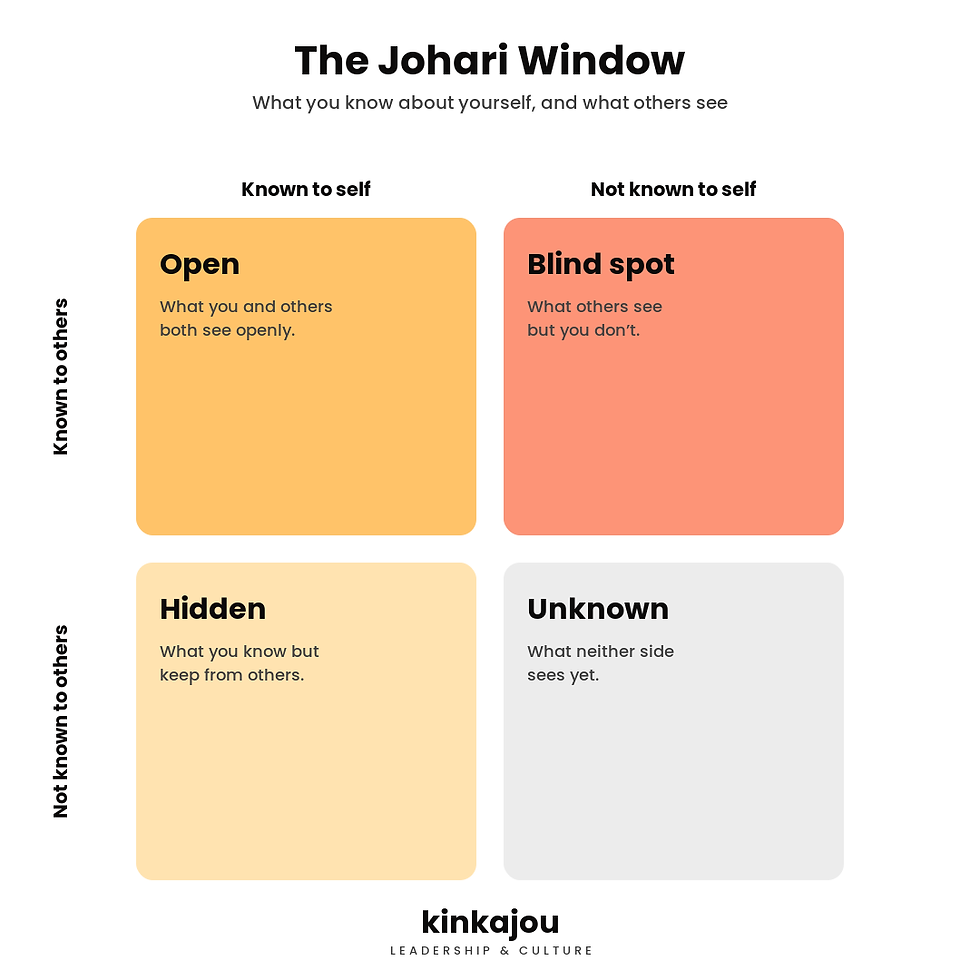
It’s also fed by our own cognitive distortions, the stories we tell ourselves about how that meeting “obviously” went. The only way to close the gap is to go looking for it.
🤔 Reflective question: when did your communication style last get in the way of your message, and would you even know?
How to reflect on your communication style
You don’t need a 40-page report. You need a habit of honest noticing. Try these:
Replay a recent high-stakes moment. Use the Four Fs, Facts, Feelings, Findings, Future.
Notice your stress default. What mode do you snap to when rushed or challenged?
Ask for it directly. “How do I come across when I’m under pressure?” is one of the bravest questions a leader can ask. See our guide to giving and receiving feedback and these 30 questions great leaders ask.
Ask five people for three words. Pick five people who see you in different settings, a colleague, your boss, a friend and a family member, and ask each for three words to describe you, and why. The patterns show up fast. This simple exercise is the one that finally worked for me.
Audit your written and async tone. Your messages and emails are often a bigger tell than your meetings.
Listen more than you diagnose. Strong communicators are first strong listeners.
Run a light-touch 360. Patterns across several people are more honest than any single moment.
💡 Tip: do this with curiosity, not a stick. The goal is awareness, not a fresh reason to be hard on yourself.
From awareness to intention
Knowing your default isn’t about slapping a label on yourself. It’s about choice. Once you can see your go-to mode, you can decide, in the moment that matters, to flex: to slow down for the quiet thinker, to add warmth to the hard message, to sit in a silence instead of filling it.
That flexing is a skill in its own right, and it’s where we’ll go in the next post in this series: adapting your communication style to different people and situations.
Conclusion
Self-awareness is the unglamorous skill behind every leader who’s genuinely good to work with. You can’t change how you come across until you can see it, and you can’t see it without stopping to look.
So pick one method above and try it this week. Notice your default, and the gap between what you meant and what landed. That noticing, repeated, is how communication style quietly improves.
Ready to sharpen how you lead and communicate? At Kinkajou, we work with leaders to build self-awareness and braver conversations.
References
Eurich, T. (2018). “What Self-Awareness Really Is (and How to Cultivate It).” Harvard Business Review. hbr.org
Scott, K. (2017). Radical Candor. radicalcandor.com
Merrill, D. W. & Reid, R. H. (1981). Personal Styles & Effective Performance. toolshero.com
Luft, J. & Ingham, H. (1955). The Johari Window: A Graphic Model of Interpersonal Awareness. Proceedings of the Western Training Laboratory in Group Development. Los Angeles: UCLA. original record
Bakan, D. (1966). The Duality of Human Existence: Isolation and Communion in Western Man. archive.org
Wiggins, J. S. (1991). Agency and communion as conceptual coordinates for understanding interpersonal behaviour. Overview: interpersonal circumplex
Abele, A. E. and Wojciszke, B. (2014). Communal and agentic content in social cognition: A dual perspective model. Advances in Experimental Social Psychology, 50, 195-255. sciencedirect.com
Fragale, A. (2024). Likeable Badass: How Women Get the Success They Deserve. Penguin Random House. penguinrandomhouse.com
Maher, N. (2023). Coaching for Gender Diversity: A Thematic Analysis of Approaches, Frameworks and their Efficacy. researchgate.net


