I have my 360-degree feedback. Now what?

The way you ask for criticism and react when you get it goes a long way toward building trust, or destroying it. Kim Scott, Radical Candor

"Regardless of how I prepare myself for getting my 360-degree feedback, when I crack it open, I spend the first few minutes scanning for the lowlights. I can't help it. But once I have time to digest and reflect on it, I always find the report enlightening." Says Nancy Maher, Kinkajou's CEO.
For most leaders, this is the hardest part: opening a report that tells you, in other people's own words, how you show up.
It generally has a mix of what you expect and a few surprises. Most leaders land somewhere between surprised and deflated or relieved after reading their 360 feedback. This guide helps you think about how to sit with it, read it well, follow up with the people who gave it, and turn it into a real development plan. If you are still deciding who to ask and how to invite them, start with our 360-degree feedback playbook.
Contents
Step 1: Zoom in
360-degree reviews are valuable because they gather insights from bosses, direct reports, and coworkers, reveal blind spots and strengths and support an individual's professional development.
All emotions are normal when you first read the report. You might feel excited, defensive, deflated, or even oddly relieved. Step back, take a breather, and talk it through with a friend, coach or a trusted colleague before you act on any of it.
Give yourself time before you respond to anyone about it, even to yourself. Skimming it once over coffee tends to lock in whatever surprised you, good or bad, as the story, before you've had a proper look at the whole thing.
💡 Tip: Write down one insight that jumped out the most. Then, next to it, write what you would tell a colleague who showed you the same line about themselves.
If the harshest line has you doubting yourself, don't let it. That voice is what is known as a Saboteur, and it's worth getting to know yours - so you can manage any unhelpful thoughts.
Step 2: Zoom out
Within a day or two, once the first reaction has settled, resist the urge to zoom in on the one comment that stings. Step back and look at the whole picture first. Treat each area of feedback as data, not a verdict. A single sharp comment is one view. A pattern across peers, reports and your manager is worth your attention. Read it the way you'd read feedback on a colleague you respect: with curiosity, fairness and some distance. That makes it easier to decide what to act on and what to simply note.
A 360-degree survey is a collection of individual perceptions. Take what's useful, and set the rest aside without needing to argue yourself out of it first.
🤔 Reflective question: What themes keep showing up, where different groups see you differently, and what surprises you?
Step 3: Reflect
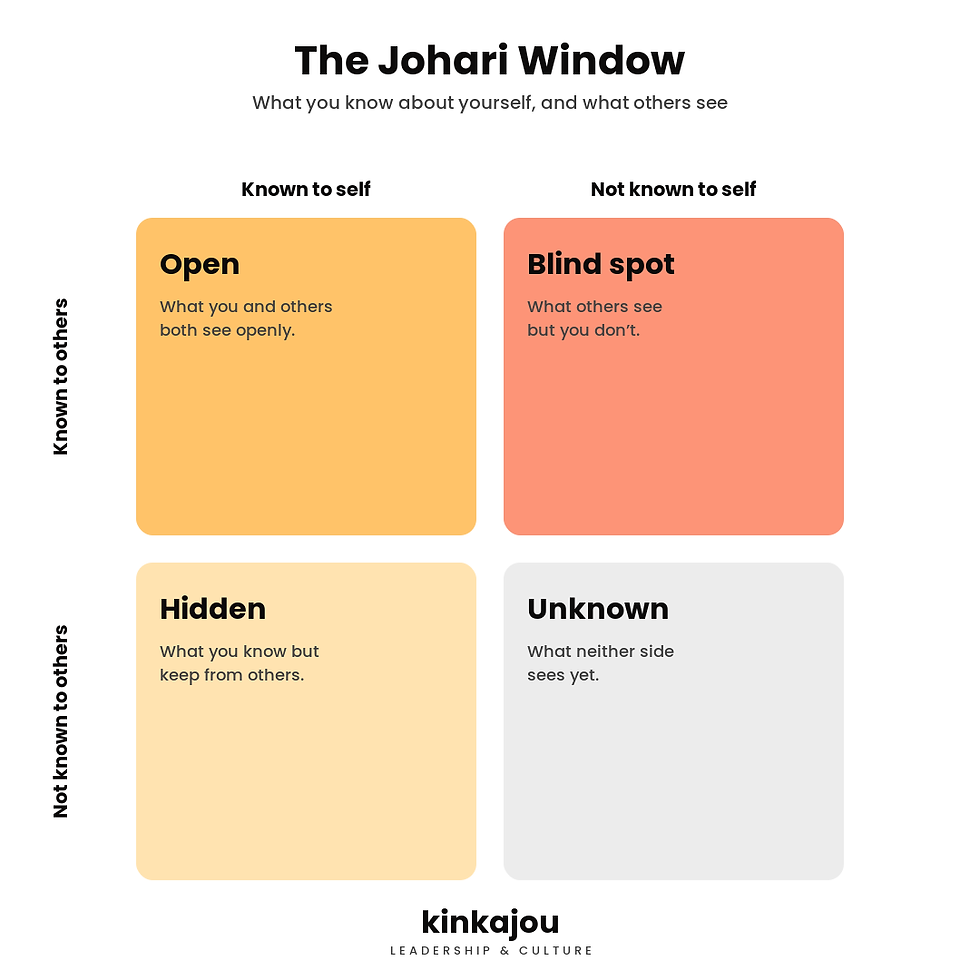
A helpful way to read your results is to sort them into four parts of The Johari Window.
Created in 1955 by psychologists Joseph Luft and Harrington Ingham, it is a practical tool for increasing self-awareness and a great tool to use to review your 360-degree feedback. Go through each box and fill in your reflections. The known-to-self parts of the window mostly confirm what you already suspected. The not-known-to-self parts, where your view and other people's differ, deserve attention.
Step 4: Consider context
Most 360-degree surveys are anonymous, and you don't know how each person has rated you. However, you may notice ratings from a particular group, like peers or direct reports, have a lot of variation. If some of your raters are new, for example, a manager who's known you for three months, they're measuring something real, but it's a narrower picture than someone who's known you for years. Read the feedback as a perspective of what they've seen so far, rather than as the full picture of you.
🤔 Reflective question: How might I be showing up differently with people who I've worked with for a shorter or longer time?
Step 5: Have follow-up conversations
In a five-year study of 252 managers, those who met with their direct reports to discuss the results improved more than those who didn't. A larger study of 5,335 feedback recipients found a similar but small effect for sharing feedback and asking for suggestions.
Use the 360 as a moment to invite more candid, forward-looking input. Most 360 degree surveys are anonymous, so don't try to work out who said what. Start with your manager and a few people you trust, and ask one of these questions. Even a short follow-up conversation can tell you more than the survey.
What feedback are you holding back?
What strengths could I develop further?
What could I do more, or less, of?
Curiosity gets you further than defensiveness. You don't have to accept every piece of feedback, but do be willing to hear it. For more on how to ask well, see our guide to giving and receiving effective feedback and our piece on giving meaningful feedback.
💡 Tip: Also thank everyone who took part - you don't have to share anything more than that.
Step 6: Create a small experiment
You can't fix everything at once, so narrow it to one question: where is your real bottleneck right now?
Current performance: something in how you are doing the job today.
A relationship: one specific working relationship that needs attention.
A future skill: something you will need for the future.
A specific task: one recurring piece of work that keeps tripping you up.
🤔 Reflective question: What is that one thing, for you, right now?
Step 7: Build a 360-degree feedback plan
⏱️ When: Within the month, then a regular check-in.
In a 2003 field study of 1,361 senior managers, those who worked with a coach to review their feedback were more likely to set specific goals and ask their supervisors for ideas, and they improved more in their direct reports' and supervisors' ratings.
Feedback is most impactful if you do something with it.
Behaviour is what a 360-degree plan aims to shift, so working through your report with a coach is a sound way to turn it into action. This is what we do at the start of our EMPOWER Leadership development programme.
Prioritise: pick the one action you will take.
Pair it with a strength: focus on what is already working and do more of it.
Write a simple plan: set a small goal and a date to look at it again.
Share your learning: let your team or coach know what you are working on.
Ask for feedback: growth is a process, not a single event.
Track progress: notice the shift, even a small one, so the process feels motivating.
Final thoughts on your 360-degree feedback
A 360 isn't a report card. It shows you how you're experienced by the people you work with. Zoom in on the detail, then zoom out to find the patterns. Take time to reflect before you react, and think about the context each comment came from. Go back to a few people and ask what they meant, because a short follow-up conversation often tells you more than the survey. Then pick one small experiment and try it. Once you see what works, build it into a plan you can stick to. You don't have to fix everything at once, start with one change and keep it going.
For more to read alongside this, our roundup of top leadership and management books is a good place to keep going.
References
Scott, K. (2017). Radical Candor: Be a Kick-Ass Boss Without Losing Your Humanity. St. Martin's Press.
Smither, J.W., London, M., Flautt, R., Vargas, Y., & Kucine, I. (2003). Can working with an executive coach improve multisource feedback ratings over time? A quasi-experimental field study. Personnel Psychology, 56(1), 23-44.
Smither, J.W., London, M., Reilly, R.R., Flautt, R., Vargas, Y., & Kucine, I. (2004). Discussing multisource feedback with raters and performance improvement. Journal of Management Development, 23(5), 456-468.
Walker, A.G., & Smither, J.W. (1999). A five-year study of upward feedback: what managers do with their results matters. Personnel Psychology, 52(2), 393-423.
Ready to build on what your 360 showed you with a coach?
Not ready for a full programme? Start with our guide to what to expect from leadership coaching.


